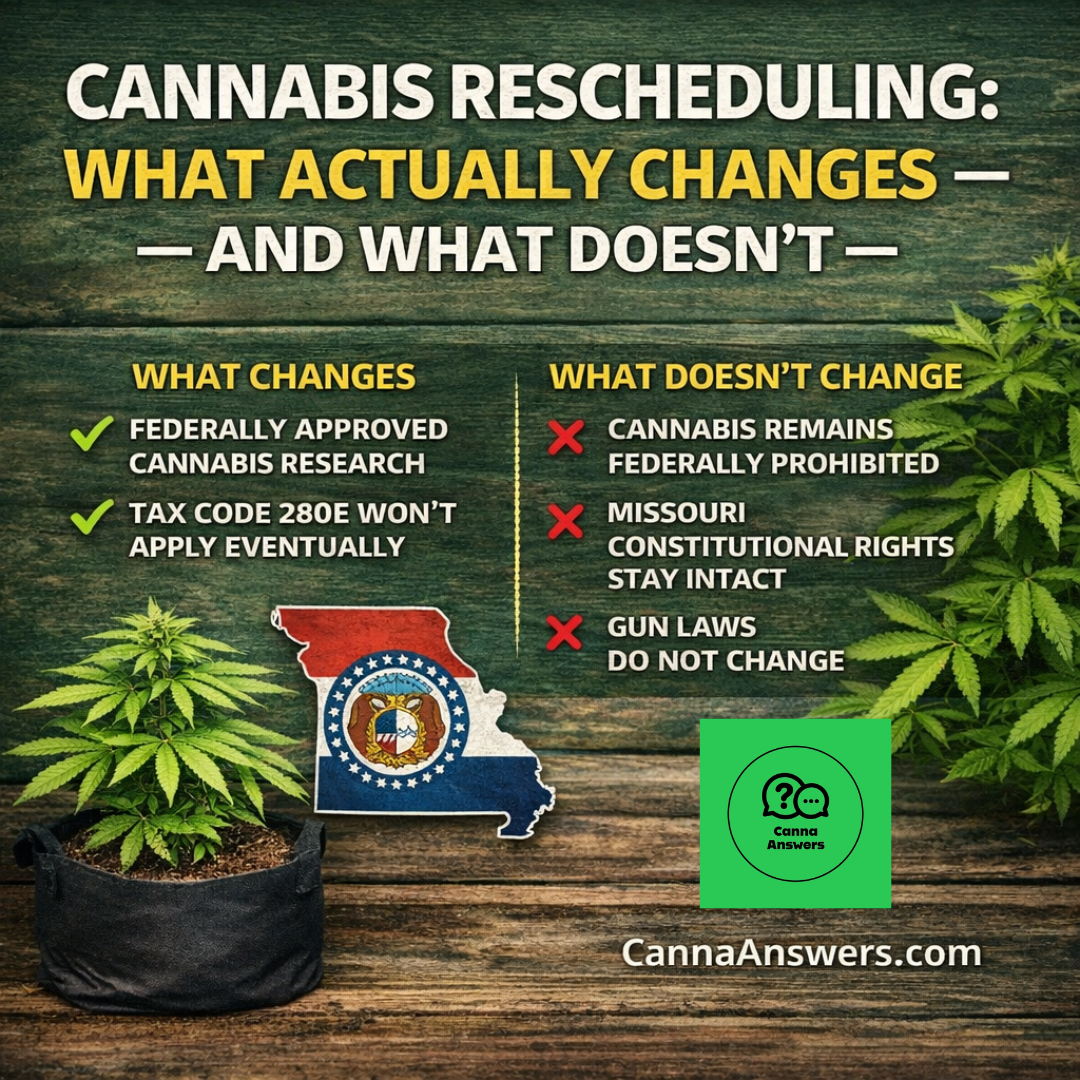
With recent news about Cannabis Rescheduling to Schedule III, there’s been a lot of excitement — and just as much confusion. Let’s slow this down and talk about this in plain English: what this actually does and does not mean in real life,
especially for Missouri patients, caregivers, and consumers.
First: What doesn’t change (and this matters)
Right now, nothing changes in your day-to-day life.
What Missourians have been doing since 2018 (medical) and 2022 (adult use) continues exactly the same:
- Patients will still get medical cards (with or without cultivation)
- Consumers will still obtain consumer cultivation permits
- Caregivers remain legal under Missouri’s constitution
- Home cultivation remains legal in Missouri
Federal rescheduling does NOT:
- Legalize cannabis at the federal level
- Create one national cannabis system
- Open interstate cannabis commerce
- Override state programs (states still call the shots)
- Change existing federal banking guidance overnight
Cannabis is still federally prohibited, even under Schedule III.
What does change — but not overnight
1) Research (this is the biggest immediate impact)
Cannabis rescheduling to Schedule III lowers barriers to federally approved research. That matters.
While many of us don’t need studies to know this plant saves lives — I personally wouldn’t be here without it — research leads to:
- Better understanding of specific conditions
- More accurate dosing
- Safer delivery methods
- Better guidance for patients and providers
Schedule III also allows agencies to use real-world evidence, meaning actual patient outcomes — not just limited lab trials.
This is especially important for seniors, veterans, chronic-pain patients, and other vulnerable populations.
To be clear: I am not advocating for a pharmaceutical-only system. Cannabis needs a unique framework that recognizes its wide range of uses and applications — from industrial to medicinal to adult use. Research is knowledge. We may learn that certain ratios, cannabinoids, terpenes, or delivery methods are better for specific conditions. What I do not want is to lose the ability to self-medicate as we see fit, even if someone wants to label that use “recreational.”
This is one of the most meaningful outcomes of rescheduling: research — and the possibility that knowledge saves lives sooner rather than later. This part is progress.
2) The 280E tax code (huge for cannabis businesses — eventually)
Once cannabis is officially removed from Schedule I/II:
- IRS code 280E no longer applies (once rescheduling is finalized and effective)
- Cannabis businesses can take normal business deductions
- Operators stop being treated like traffickers under the tax code
This does not mean:
- Retroactive refunds
- Instant financial relief
But it does mean the industry can begin operating more like every other legal business — which helps stabilize prices, wages, and access long-term.
3) Banking (movement, not a miracle)
Rescheduling does not automatically fix cannabis banking. However, it:
- Reduces perceived federal risk
- Opens the door to more productive conversations
- Makes future reform more realistic
The removal of 280E also makes cannabis businesses more financially viable — or at least less likely to operate at a loss — because they can deduct normal business expenses.
That eventually makes them more attractive to lenders. Again: eventually, not overnight.
This is progress — maybe sideways, maybe slightly forward — but it is not a finish line.
Hemp, CBD, and why this part is a big deal
One of the most important — and often overlooked — parts of the Executive Order is how directly it addresses hemp-derived cannabinoids, especially full-spectrum CBD.
Hemp products are federally legal, widely used, and relied on by millions of Americans — yet the lack of clear federal standards has hurt patients, consumers, and responsible businesses while doing little to improve safety.
The Executive Order directs the White House to work with Congress to:
- Protect access to appropriate full-spectrum CBD products
- Restrict products that pose genuine health risks
- Move away from blanket bans and toward science-based standards
Clear federal standards mean consumer protection, not prohibition-by-another-name.
Medicare, doctors, and CBD: why this matters for patients and seniors
Another major shift is the federal government acknowledging that CBD belongs in healthcare conversations, not outside of them.
The Order opens the door for:
- Doctors to prescribe or recommend CBD products
- CBD products to potentially become eligible for Medicare coverage
- Better guidance for seniors, veterans, and chronic-care patients
This matters because:
- Nearly 15% of seniors report using CBD
- One in five U.S. adults has used CBD in the past year
- Many patients already rely on CBD for pain, inflammation, sleep, and quality of life — often without medical guidance due to outdated federal policy
Bringing CBD into a regulated medical framework doesn’t force anyone to use it. It allows accurate information, standards of care, and safer access.
Important clarification: gun rights
Rescheduling does not automatically restore gun rights under federal law.
Because cannabis remains federally prohibited:
- The “unlawful user” issue still exists
- Firearm restrictions tied to federal law are not resolved by Schedule III alone
This is one area where descheduling, not rescheduling, would be required for true change.
Schedule III vs. descheduling (the bigger conversation)
Schedule III still means:
- Federal control
- Federal prohibition
- Continued restrictions
Descheduling would mean:
- Ending federal prohibition
- Restoring civil liberties
- Treating cannabis more like alcohol or tobacco
Rescheduling changes who profits. Descheduling changes who is free.
Bottom line
Still regulated. Still restricted. Still criminalized at the federal level. We still have prohibition in many ways.
For patients, caregivers, and consumers:
- Keep doing what you’ve been doing
- Your Missouri rights remain intact
- Nothing changes overnight
This is movement — but it is not freedom yet.
Official Source
The White House fact sheet outlining the Executive Order’s focus on research, CBD access, and rescheduling can be found here:
White House Fact Sheet (Dec 18, 2025)
Helpful Missouri resources from Canna Answers
- Missouri Medical Cannabis Cards (patient card help)
- Rules for Patients, Caregivers, and Consumers
- FAQ
- Missouri Consumption Lounges
- Microbusiness License Guide
I can help you navigate Missouri patient cards, caregiver/cultivation rules, and what federal changes do (and don’t) mean for you.