Missouri’s medical marijuana rules can be confusing for adults — and even more overwhelming when you’re trying to help
a child who may benefit from cannabis. Whether your child is dealing with seizures, chronic pain,
autism-related behaviors, or another serious condition, you deserve clear answers and a process that does not
leave you guessing.
This blog is the conversational companion to my full guide,
Missouri Medical Marijuana for Minors (2025 Guide).
If you want the legally structured version with every detail organized, start there. If you want a parent-to-parent style walkthrough,
keep reading — this one is Missouri’s minor medical marijuana rules, explained in plain English.
Questions? You can always call Deb at 417-439-0947 for personalized guidance.
Can a Minor Really Get a Medical Marijuana Card in Missouri?
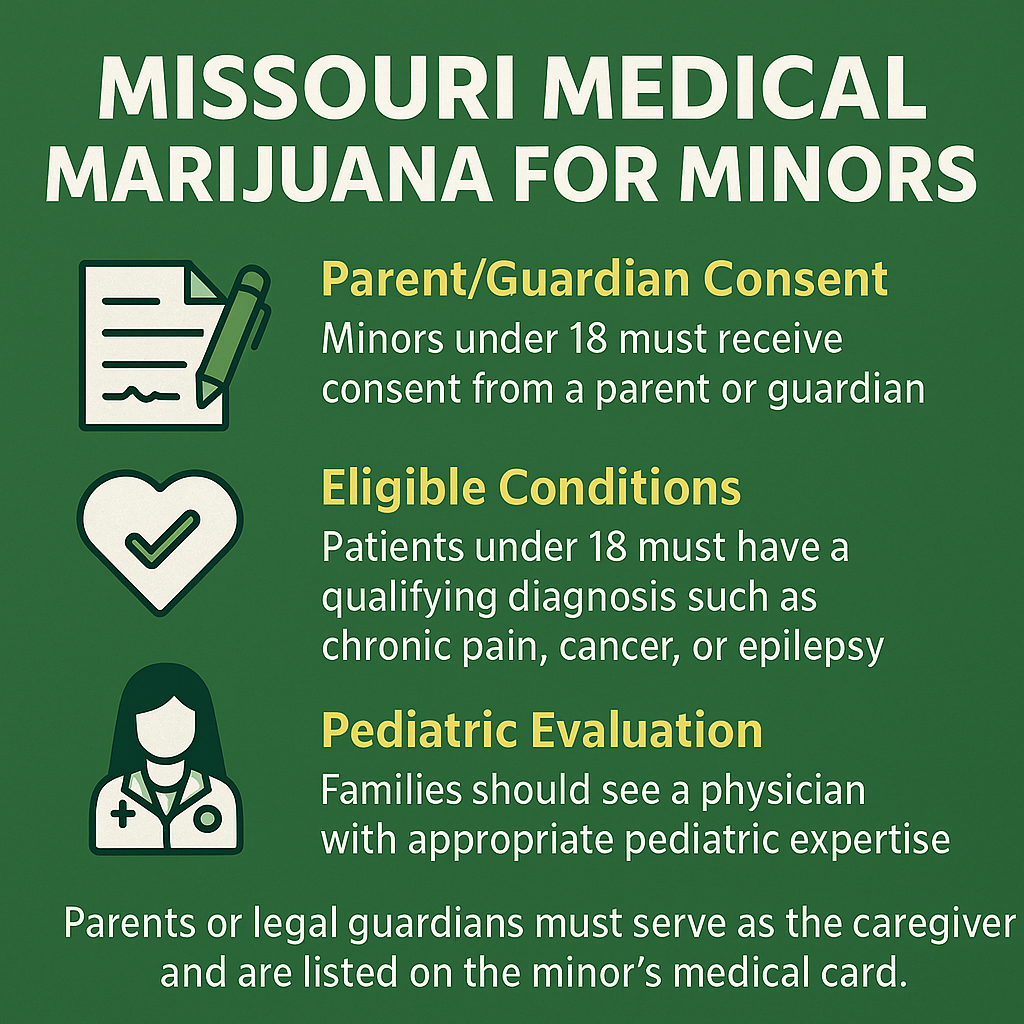
Yes. Under Missouri law, a person under 18 can qualify for a Missouri medical marijuana card when:
- A Missouri-licensed MD/DO believes cannabis may help manage their symptoms, and
- A parent or legal guardian agrees and serves as the child’s caregiver.
The most common situations I see include:
- Seizure disorders and epilepsy
- Severe chronic or neuropathic pain
- Autism-related agitation, anxiety, or self-injurious behaviors
- Autoimmune and inflammatory conditions with significant pain
- Other serious conditions where traditional treatments haven’t helped enough
Every child is different. The physician’s job is to decide whether the potential benefits of medical marijuana may outweigh the risks
for that specific minor.
Why Working With a Pediatrician Matters
Many Missouri card clinics either don’t see minors at all or quietly discourage them. That leaves families feeling stuck — especially
when a child has already tried multiple medications with limited success.
I partner with Dr. James McEntire, a practicing pediatrician who regularly evaluates minors for medical
marijuana when medically appropriate. He understands both the potential benefits and risks of cannabis. That means:
- The visit feels like a normal pediatric appointment — not an interrogation.
- The doctor already understands childhood development and complex medical histories.
- Parents can ask honest questions without feeling judged.
If you want the structured explanation of how minor evaluations work, you can also read the full guide:
Missouri Medical Marijuana for Minors (2025 Guide).
The Parent or Guardian’s Role as Caregiver
For minors, a parent or legal guardian must serve as the caregiver. That means you are the one who:
- Applies in the DCR/DHSS portal
- Holds the minor’s card (if you print it)
- Visits dispensaries and purchases the minor’s medicine
- Stores products securely and supervises use
- Handles any cultivation authorization, if you choose to grow for your child
Missouri uses two key documents for minors:
-
Parental Consent Form — confirms that you understand and approve your child’s use of medical marijuana.
The state’s sample is here:
Sample Parental / Legal Guardian Form (PDF)
. -
Patient Authorization / Caregiver Form — identifies who will act as caregiver in the portal and at dispensaries:
Patient Authorization Form (PDF)
.
During appointments, I walk families through which forms are required and how to complete them. Many parents use basic photo-editing tools
to fill them out, but if you prefer paper, I’m happy to mail printed copies — then you can snap a quick photo to upload.
What Does It Cost? (Minor & Caregiver Fees)
There are two different types of costs to plan for: my service fees and state application fees.
Minor Patient Card – $133 Total Through Canna Answers
I charge $133 for a minor (or adult) patient card. This includes:
- The doctor’s fee for the evaluation with Dr. McEntire
- The state patient fee for the patient card
- My time to complete the patient portal application, uploads, and support for 3 full years
Caregiver Application – My Fee + State Fees
For the caregiver (parent or legal guardian), there are two pieces:
-
$25 — My caregiver application support fee (to create and submit the caregiver application).
I routinely waive this fee for low-income families who need the help. -
State + processing fees — when paid through my card, the totals typically work out to about:
- $33 – Caregiver card without cultivation
- $93 – Caregiver card with cultivation authorization
So for most families using my services, caregiver costs look like:
- Caregiver card only → about $33 in state/processing fees + my $25 caregiver fee
- Caregiver card with cultivation → about $93 in state/processing fees + my $25 caregiver fee
In other words: $191 non-cultivating or $221 with cultivation is the typical all-in cost for the minor’s card
when we work together (based on the fee structure above). I always review fees with you before we apply so nothing is a surprise.
For a deeper breakdown of Missouri fees and rules (including adult patients), visit:
Missouri Medical Cannabis Cards – Apply or Renew.
Documents You’ll Need for a Minor & Caregiver Application
To keep the application process smooth, it helps to gather a few documents before we start. In most minor cases, you’ll need:
For the Minor (Patient)
- Passport-style photo or clear selfie of your child – shoulders up, plain background, no filters.
- Government-issued ID, if they have one (state ID, driver’s permit, passport, etc.).
- Birth certificate or proof of legal guardianship – especially important if your last name is different or there is a custody order.
For the Parent or Legal Guardian (Caregiver)
- Passport-style photo or clear selfie of the caregiver – shoulders up, plain background, no filters.
- Government-issued ID for the caregiver (Missouri driver’s license, state ID, or passport).
- Proof of legal guardianship, if you are not the biological parent or if there is a court order in place.
If you’re not sure whether a document will work, I can look at what you have and help you decide the best way to submit it.
During our appointment support session, I can also show you how to take acceptable photos on your phone and upload them into the portal.
What a Minor Appointment Actually Looks Like
Most parents are nervous before the first visit. In reality, minor appointments with Dr. McEntire feel very similar to any other pediatric visit,
just with extra time built in for questions about cannabis.
You can expect to talk about:
- Your child’s diagnosis and current symptoms
- Medications and treatments that have already been tried
- How symptoms impact school, home life, sleep, and mood
- What you hope medical cannabis might help with
- How you plan to store products safely and supervise all use
You do not need to be an expert in strains, doses, or products — that’s what the program and resources are for.
Step-by-Step: How the Minor Application Works (Without the State Jargon)
There are two ways to handle the application process: doing it yourself in the portal, or letting me do it for you.
Option 1 – Doing It Yourself in the State Portal
- See a physician. Many families work with Dr. James McEntire, a pediatrician who understands minors and medical cannabis.
- Complete the parental consent and caregiver authorization forms. These confirm that you approve your child’s use and agree to act as caregiver.
- Create the child’s patient profile. In the DCR/DHSS portal, create a minor patient profile, upload the certification and forms, and pay the state patient fee.
- Wait for approval of the minor’s card. Once approved, download or print the minor’s patient card.
- Create the caregiver profile. Register yourself as caregiver, link to your child, and pay the caregiver (and cultivation, if applicable) fees.
- Wait for caregiver approval. After approval, download or print your caregiver card.
- Visit dispensaries as the caregiver. Bring both cards — yours and your child’s — when purchasing medication.
Option 2 – Working With Canna Answers (Most Families Choose This)
If you work with me, the process is much easier. In most cases, all you have to do is:
- Schedule and attend your child’s appointment with Dr. McEntire.
- Send me the doctor’s certification, parental consent, and required IDs/documents.
- Click the verification link for your state portal account when I send it.
I handle the rest:
- Creating or updating the minor’s patient profile
- Uploading all required documents
- Submitting the minor application
- Submitting the caregiver application and linking it correctly
- Monitoring for errors or rejections and fixing them
- Letting you know when both cards are approved and ready to download
Most families verify their email and then simply wait for approval emails. I handle the on-screen navigation so nothing important gets missed.
What About Legal Protections for Families?
Many parents quietly worry: “Will this hurt us in family court?” or “Can someone use this against us later?”
Missouri’s constitution includes family protections for lawful medical cannabis patients and caregivers.
While no blog can replace individualized legal advice, you can read more here:
Missouri Cannabis Family Protections.
If your situation involves custody or an active court case, consider speaking with an attorney who understands Missouri cannabis law.
Need Help With a Minor or Caregiver Application?
I work with families statewide via virtual appointments. Whether you’re starting from scratch, renewing, or correcting past applications,
you don’t have to do this alone.
Here’s a quick summary of the common fees:
- $133 – Minor (or adult) patient card – includes doctor visit, state fee, and portal assistance
- $25 – Caregiver application support (often waived for low-income families)
- Caregiver state + processing fees: about $33 without cultivation, or $93 with cultivation
For a full breakdown of cards, renewals, and options, visit:
Missouri Medical Cannabis Cards – Apply or Renew.
When you’re ready:
Book an Appointment – Minors & Caregivers
And if you’d like the formal, structured version of everything in this blog, return to the main guide:
Missouri Medical Marijuana for Minors (2025 Guide).
Disclaimer: This blog is for educational and informational purposes only. Canna Answers LLC does not provide legal services and does not
encourage or promote any illegal activity. Always follow all applicable local, state, and federal laws and regulations, and consult an attorney for legal
advice specific to your situation.