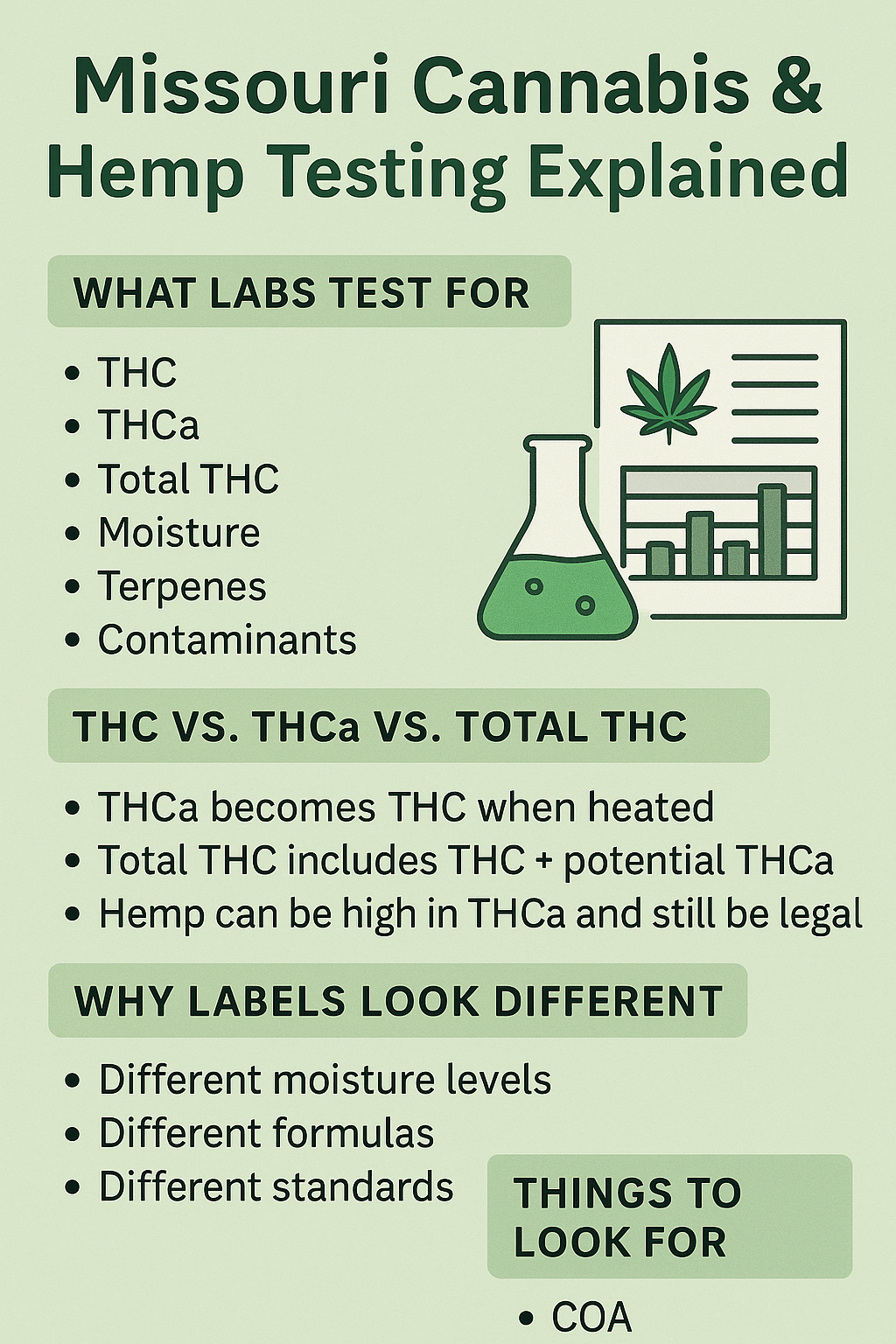
“total THC,” and hemp products often look almost identical to dispensary flower on a lab report.
This plain-English guide explains how Missouri cannabis testing works, how hemp is tested,
and why both can look the same on a certificate of analysis (COA) even though they fall under
different rules. Plain-English overview of Missouri cannabis and hemp testing: what labs measure,
THC vs THCa vs total THC, and label differences.
Missouri Cannabis FAQ,
Missouri Medical Cannabis Cards,
and Missouri Cannabis Events & Calendar pages.
It is educational only and does not replace legal, medical, or tax advice.
What Labs Test for in Missouri Cannabis & Hemp
While every licensed Missouri lab has its own equipment and workflow, most cannabis and hemp tests look at a
similar set of things:
- Cannabinoids: THC, THCa, CBD, CBDa, and other minor cannabinoids
- Potency totals: “Total THC” and “total CBD” based on lab formulas
- Moisture or water activity: helps determine shelf stability and can slightly change numbers
- Terpenes: the aromatic compounds that influence smell and effects
- Contaminants: residual solvents, heavy metals, pesticides, microbes, and mold
Not every product is tested for every category, but most flower and manufactured products in the regulated
Missouri cannabis system go through potency and safety testing before they can be sold in licensed dispensaries.
THC vs. THCa vs. Total THC
One of the most confusing parts of cannabis and hemp testing is the difference between THC,
THCa, and total THC. Understanding these three terms makes most labels much easier to read.
THCa: The “Raw” Form of THC
THCa (tetrahydrocannabinolic acid) is the form of THC found in raw flower. It is not strongly
intoxicating on its own. When THCa is heated through smoking, vaping, or baking, it converts to THC in a process
called decarboxylation.
THC: The Decarboxylated Form
THC (delta-9 tetrahydrocannabinol) is the form that most people associate with the “high.”
Lab reports on raw flower usually show a smaller delta-9 THC number, because most of the potential potency is still
in the THCa form before heating.
How THCa Converts to THC (Decarboxylation)
When cannabis is heated, THCa loses a small part of its chemical structure and becomes THC. Labs can account for this
conversion by using a mathematical formula that estimates how much THC would be produced if all of the THCa were fully
decarboxylated. This is where “total THC” comes from.
Total THC: THC + Potential from THCa
Total THC is a calculated number that combines the measured THC with the potential THC that could
be created from THCa after heating. That is why a flower can test as high in THCa and still meet hemp or cannabis rules
depending on how the law defines “total THC.” In Missouri’s regulated cannabis system, total THC is often the main
number used for potency labeling.
How Hemp Is Tested vs. How Cannabis Is Tested
Missouri has two different testing frameworks operating side by side: one for hemp under federal
USDA rules, and one for cannabis under Missouri’s medical and adult-use regulations. The plants
themselves can look and test very similar on paper, but the rules treat them differently based on when and how
the sample is taken.
Hemp Testing: Pre-Harvest Under USDA Rules
Hemp is typically tested before harvest while plants are still growing in the field. Under the
current federal framework:
- A certified sampler cuts the top portion of the flower from selected plants.
- The lab measures delta-9 THC directly in that pre-harvest sample.
- Compliance is based on delta-9 THC ≤ 0.3% at the time of sampling.
- THCa is not decarboxylated for compliance; it is not the deciding factor in whether a plant is legally hemp.
- “Total THC” formulas are generally not used to determine whether a hemp crop is compliant.
That means hemp flower can show high THCa on a COA and still be federally compliant, as long as the pre-harvest
sample stayed at or below 0.3% delta-9 THC.
Note: I am registered as a USDA hemp sampler, which means I am familiar with the rules and procedures, but I do not
perform sampling. Instead, please contact Kyle Huff of Sleepy Trees.
This guide is for education only.
Missouri Cannabis Testing: Post-Harvest Under State Rules
Cannabis sold in Missouri dispensaries is tested after harvest, after drying and curing, and often
before final packaging. A typical Missouri cannabis COA may include:
- THCa and delta-9 THC
- Total THC and total CBD (calculated values)
- Full panel safety tests for contaminants
- Moisture or water activity
- Terpene profile
For cannabis, the focus is on total THC and overall safety for consumers, not just the pre-harvest
delta-9 THC number.
Why Dispensary Cannabis Would Look Like Hemp Under USDA Testing
Here is the piece most people never hear: if you took a Missouri dispensary flower and sent it through the
hemp testing process (pre-harvest style, delta-9 THC only, no conversion), its delta-9 THC would also be
very close to or below 0.3% in that raw form. In other words, if the only rule was “delta-9 THC ≤ 0.3%
before decarboxylation,” most dispensary flower would qualify as hemp under that narrow definition.
Hemp and cannabis are not different species. They are the same plant being processed through two different
legal frameworks:
- Hemp: defined by pre-harvest delta-9 THC at or below 0.3%.
- Cannabis: defined and labeled using total THC and full safety testing after harvest.
This is why hemp flower and dispensary flower can look nearly identical on a lab report. The difference is in the
rules and timing of testing, not in the basic chemistry of the plant.
Total THC vs. Delta-9 THC in Rules and Enforcement
For hemp, federal enforcement focuses on the pre-harvest delta-9 THC result. For Missouri cannabis,
regulatory focus is on total THC and whether products passed required safety tests before sale.
Law enforcement and regulators sometimes mix these concepts, which leads to confusion about what is “legal” hemp,
what is cannabis, and why they look the same on COAs.
Why Cannabis & Hemp Labels Look Different
It is normal for labels from different Missouri brands, labs, and markets to look a little different. Some of the
most common reasons include:
- Different lab formulas: each lab may use slightly different rounding or calculation methods for totals.
- Moisture content: products tested at different moisture levels can show different potency percentages.
- Reporting style: some labels show THCa and THC separately, others emphasize total THC.
- Hemp vs cannabis labeling: hemp products outside the dispensary system may follow federal labeling norms instead of Missouri cannabis templates.
- Batch differences: even within the same strain, different batches can test with slightly different numbers.
Hemp COA vs. Cannabis COA: What Is the Difference?
A hemp COA and a cannabis COA can look very similar at first glance, but there are important differences in what
is required and how results are reported.
Typical hemp COA:
- Focuses on cannabinoids, especially delta-9 THC and THCa.
- Compliance is based on delta-9 THC at or below 0.3% at sampling.
- May or may not include a full safety panel (pesticides, metals, microbes, etc.).
- Formatting can vary widely between labs.
Typical Missouri cannabis COA:
- Includes THCa, delta-9 THC, total THC, CBD, and other cannabinoids.
- Uses total THC for potency labeling in the regulated system.
- Includes required safety tests for contaminants before dispensary sale.
- Follows more standardized state expectations for content.
The chemistry of the plant is similar, but the regulatory requirements and reporting styles are different.
Moisture and Potency: Why Numbers Change
Moisture content can also change how potency numbers look:
- Drier product has less water, so cannabinoids take up a larger percentage of the total weight.
- More humid product carries more water, so the same amount of cannabinoids shows as a lower percentage.
- Storage, curing, and handling can all affect moisture and, with it, the reported potency.
Small differences in potency between batches or labels do not automatically mean something is wrong. However, very
large jumps or missing lab information can be a sign to ask more questions.
How to Read a Basic Certificate of Analysis (COA)
A certificate of analysis, or COA, is the full lab report for a specific batch of product. Many
Missouri brands provide QR codes or website links where you can look up COAs for flower, concentrates, and hemp products.
Key Sections to Look For
- Product and batch ID: the strain name or product name and batch/lot number.
- Lab information: the name and license number of the testing lab, if applicable.
- Cannabinoid profile: a table that lists THC, THCa, CBD, and other cannabinoids.
- Total THC and CBD: calculated values that combine the “raw” and converted forms.
- Pass/Fail sections: results for pesticides, heavy metals, microbes, and other safety checks (more common and required in the cannabis system).
- Date tested: when the sample was analyzed.
A clean COA makes it easier to compare products, understand potency, and confirm that a product passed safety
checks before it reached the shelf.
Missouri-Specific Testing Notes
Missouri’s regulated cannabis market operates under state rules that set minimum testing requirements for licensed
dispensaries and manufacturers. Hemp products, especially those sold outside the dispensary system, may fall under
a different combination of federal and state rules. That is part of why THCa hemp flower can look similar to
dispensary cannabis on a COA even though it is sold in a separate market.
For patients, caregivers, and consumers, the most practical approach is to:
- Look for recent, batch-specific COAs.
- Check that the lab or testing provider is clearly identified.
- Review total THC and CBD rather than focusing only on one number.
- Make sure the product passed safety tests, not just potency — especially in the regulated cannabis system.
If you are a small business or advocate who needs help understanding how testing connects to Missouri rules,
the Rules for Patients, Caregivers, and Consumers page
and the Missouri Microbusiness License page may also be helpful.
Need Help Making Sense of Missouri Cannabis or Hemp Testing?
If you are confused by lab reports, THCa numbers, or the difference between hemp and cannabis labels,
Canna Answers offers education-focused appointments to walk through real examples in plain English.
This can be especially helpful for new patients, caregivers, or small business owners trying to understand how
testing fits into Missouri’s rules.
Book an appointment with Canna Answers
Last updated January 5th, 2026. All appointments focus on education and policy navigation. Canna Answers LLC does not provide legal, medical, or tax advice.
For personalized medical decisions or legal strategy, please consult a licensed professional.
Important Disclaimer
This page is for general educational and informational purposes only. Missouri testing rules and regulations may change,
and individual labs can have different methods or reporting styles. Always confirm current requirements with official
state sources or a qualified professional before making decisions about compliance, business operations, or personal health.
.